How the Onion Dome Came To Be – A Volga German - Russian Partnership
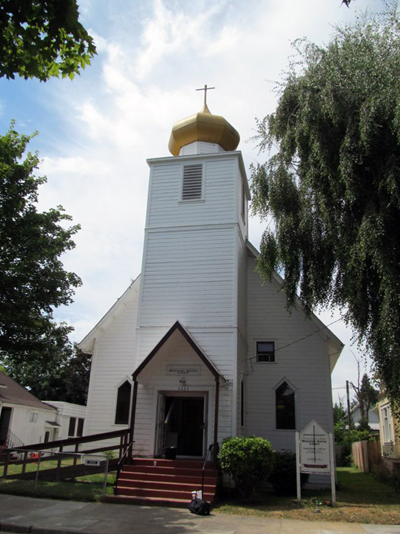
The belfry of the Free Evangelical Brethren Church (later the German Congregational Brethren Church) was originally formed by a four-sided pyramidal peak, which was an economical form of a spire. Its transformation to a Russian onion dome was a partnership forged between a Russian Orthodox Friar and a Volga German craftsman.
The Russian Orthodox priest, Friar Constantine Lebedev, and his family lived in a large home on NE 9th and Beech. The living room of Friar Lebedev's home also served as a chapel until a growing congregation outgrew the space. When the German Congregational Evangelical Brethren Church began building a new structure at NE Mason and Garfield in 1926, the St. Nicholas Orthodox Church purchased the church building on NE Mallory from the Volga German congregation. The church was adjacent to the backyard of Conrad and Christina Weber, a Volga German family from Norka, Russia. Conrad Weber soon became friends with Friar Lebedev, who knew that Conrad was a carpenter. Friar Lebedev asked Conrad to help construct an Orthodox-style onion dome for the church's belfry. Conrad was a real "go-getter," he quickly put up scaffolding and started to build. The dome was constructed in Conrad’s garage and installed atop the steeple. Conrad was proud of his work and would climb up the belfry periodically to paint the dome a brilliant gold color.
The Russian Orthodox priest, Friar Constantine Lebedev, and his family lived in a large home on NE 9th and Beech. The living room of Friar Lebedev's home also served as a chapel until a growing congregation outgrew the space. When the German Congregational Evangelical Brethren Church began building a new structure at NE Mason and Garfield in 1926, the St. Nicholas Orthodox Church purchased the church building on NE Mallory from the Volga German congregation. The church was adjacent to the backyard of Conrad and Christina Weber, a Volga German family from Norka, Russia. Conrad Weber soon became friends with Friar Lebedev, who knew that Conrad was a carpenter. Friar Lebedev asked Conrad to help construct an Orthodox-style onion dome for the church's belfry. Conrad was a real "go-getter," he quickly put up scaffolding and started to build. The dome was constructed in Conrad’s garage and installed atop the steeple. Conrad was proud of his work and would climb up the belfry periodically to paint the dome a brilliant gold color.
Sources
Kris Wunsch Zelinka, electronic mail, May 26, 1999.
The Oregonian, January 5, 1961, article by Mervin Shoemaker titled Bulbous Russian Dome Tops Church Where Old World Rites Hold Sway, p. 21.
Website of St. Nicholas Orthodox Church, 2015.
The Oregonian, January 5, 1961, article by Mervin Shoemaker titled Bulbous Russian Dome Tops Church Where Old World Rites Hold Sway, p. 21.
Website of St. Nicholas Orthodox Church, 2015.
Last updated October 25, 2023